
How Small Businesses Can Plan A Promotional Product Budget That Delivers Real ROI
If you run a small business, you know how it goes. You spot a great promotional item, see a low price per piece, and think, “That’s a steal.” But choosing promotional products based on price alone does not always deliver the best return on investment (ROI). The real value comes from selecting items that reach the right audience, support your marketing goals, and generate meaningful brand exposure within your budget. A little planning before you order can help your business get more from every marketing dollar.
Key Takeaways
- Start with a clear plan. Define the campaign goal, the audience, and a total budget that includes setup, shipping, and extras.
- Estimate a realistic number of recipients, add a small buffer, and consider a tiered approach: affordable items for broad distribution and premium gifts for high-value contacts.
- Let your distribution plan guide product choice. Lightweight, compact items are cheaper to hand out or mail.
- Compare total value, not just price per piece. Look at the product, imprint method, colors, and shipping options.
- Track cost per recipient by dividing your total campaign cost by the number of people reached.
- Give with a purpose. Pair items with a next step, such as a QR code or discount code, and follow up to measure results.
- Choose artwork and an imprint method that match your budget, and request a quote when your order has multiple products or customization options.
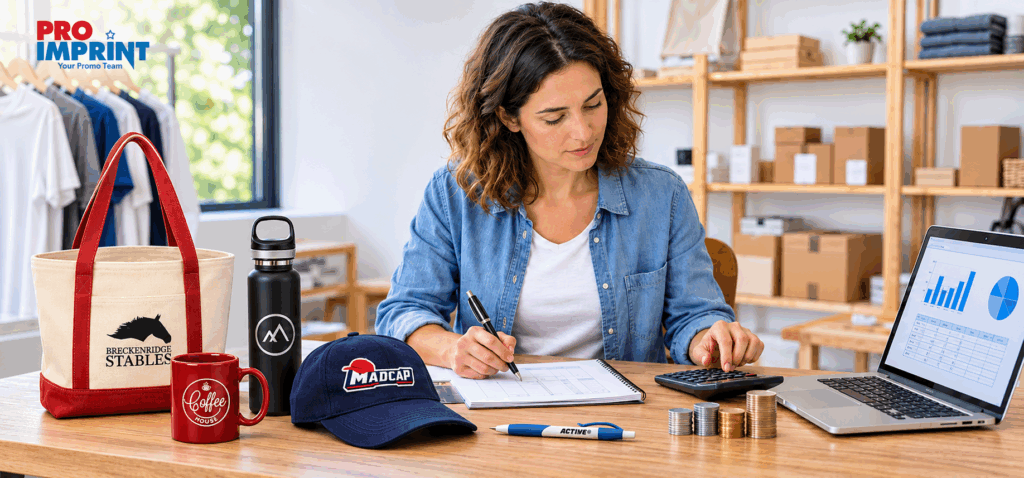
Promotional products can give small businesses an affordable way to reach customers and strengthen brand recognition without committing to large advertising campaigns. A branded tote bag carried by a customer, a tumbler with a logo on an employee’s desk, or a pen distributed at a community event can introduce your business to new audiences. However, getting the most from these purchases requires choosing products that fit your marketing goals and available resources.
Whether you are preparing for a local trade show, welcoming new customers, promoting your services in the community, or recognizing employees, a well-planned promotional product budget helps you make informed purchasing decisions. The following steps will help your small business manage promotional spending while getting meaningful value from every order.
How to Work within Your Promotional Product Budget
For a small business, promotional product budgeting involves balancing affordability with marketing effectiveness. Unlike larger companies with dedicated promotional merchandise budgets, smaller teams often need to allocate funds across several business priorities. Identifying your audience, estimating order quantities, and understanding the complete purchase cost can help you avoid unnecessary spending.
Define Your Goal, Audience, and Total Budget
Before browsing promotional products, identify what you want your campaign to accomplish. A simple plan helps small business owners prioritize spending instead of purchasing items without a defined purpose.
- What is the goal? Brand awareness, event traffic, customer thank-yous, and employee appreciation all call for different products.
- Who is it for? A gift for your top ten clients is a different purchase than 500 giveaways for a community fair.
- What is the total budget? Set a ceiling for the whole campaign, not just the product. Setup, shipping, and extras all count.
Small businesses that determine clear objectives and document their promotional strategy typically achieve greater cost efficiency than those that make purchasing decisions without a plan. Even a brief written outline helps your team stay focused and avoid unplanned expenses.
Count the People You Actually Want to Reach
The number of recipients is the primary factor influencing your promotional product budget. Estimate how many individuals will realistically receive an item and include a modest buffer to accommodate last-minute additions. Here are some examples:
- Trade show: Guess how many booth visitors you think you’ll get, then determine which of those will receive a giveaway. Consider offering practical, budget-friendly items to a broad audience and reserving premium gifts for qualified leads to maximize your promotional budget.
- Client appreciation: Count your active accounts and key contacts. A smaller quantity lets you choose a higher-quality gift.
- Employee appreciation: Calculate your current team size and account for expected new hires. Even small businesses with limited employee recognition budgets can find thoughtful options without overspending.
Ordering for every contact is not always the most effective strategy. Implementing a tiered approach, selecting cost-effective items for broad distribution and premium gifts for high-value recipients, can help your business maximize the impact of your budget. Explore these employee gifts under $15 for affordable ideas that help recognize team contributions and make employees feel appreciated.
Match Promotional Products to Your Distribution Plan
How you distribute promotional products can influence both your product selection and overall campaign expenses. Small businesses should consider whether they’ll hand out items locally, mail them to customers, include them with purchases, or display them at their business location.
- Handing out at events: Smaller, lighter products are cost-efficient to ship and easy for attendees to carry. Items people can use right away, such as custom hand fans, work well in warm outdoor settings.
- Mailing to clients or remote employees: Multiple-address shipping can be expensive. Compact, durable items, such as branded pens, notebooks, or lightweight tech accessories, are easy to pack and ship, helping manage delivery costs while giving recipients practical products they can use.
- Including with orders: A small item tucked into a customers package is a low-cost way to build loyalty. Products such as branded stickers or keychains can add a thoughtful touch without significantly increasing package size or weight.
- Leave at the front desk or in a waiting area: Practical items, such as branded pens or notepads, give visitors something useful to take while keeping your business name visible in the reception area.
Think about your timeline, too. If your event is close, 24-hour rush products can help you stay on schedule, but account for any rush-related costs in your budget.
Compare Promo Products by Total Value, Not Just Price Per Piece
Once you have set your quantity and distribution plan, compare products based on overall value rather than price alone. For small businesses, the goal is to find promotional merchandise that fits the available budget while still meeting customer expectations.
| Factor | What to Compare | Why It Matters |
| Products | Usefulness, durability, perceived value, brand fit, price per unit | Useful products are more likely to be kept and used, extending brand exposure. |
| Imprint methods | Pad printing, digital printing, embroidery, debossing, laser engraving, UV printing | The method affects logo clarity, durability, product compatibility, and cost. |
| Colors | Product color, logo contrast, brand-color matching, available colorways | Strong contrast improves visibility; consistent colors protect brand identity. |
| Shipping options | Delivery time, shipping cost, packaging, tracking, rush availability | Shipping and timing can materially affect the total budget and campaign launch. |
Small businesses working with tight marketing budgets can also explore affordable merchandise without compromising their promotional goals. ProImprint’s Under $1 Giveaways collection offers budget-friendly options for trade show handouts, mass mailer campaigns, fundraising activities, and other large-scale promotions. Comparing these lower-priced products can help smaller teams reach more recipients while keeping per-item expenses manageable.
Shipping is also a major consideration in planning your total promotional product budget. Weigh different shipment timeframes, varying shipping rates, and supplemental packing and rush fees before deciding. These factors affect the bottom line and should be considered alongside the cost of the individual item.
How to Maximize ROI on Your Promotional Product Budget
A limited promotional budget makes it especially important for small businesses to understand what each campaign should achieve. Rather than measuring success by the number of products distributed, focus on whether your merchandise attracts customers, generates leads, encourages repeat purchases, or strengthens existing relationships.
Define what success looks like: Decide in advance what you want the campaign to deliver, such as new leads at a trade show, repeat purchases from customers, or stronger employee engagement. A clear target makes it easier to judge whether the spend was worthwhile.
Match the product to the audience: Items people use every day earn more exposure over time. A custom tote bag that is reused for errands or a metal travel mug kept at a desk keeps your brand visible long after the event ends.
Track cost per recipient, not just cost per piece: Divide your total campaign cost, including imprinting, setup, and shipping, by the number of people you reach. For example, a $1,200 campaign that reaches 300 people comes to $4 per person. This makes it easier to compare options and spot where a small upgrade could improve results.
Give with a purpose: Pair your item with a clear next step, such as a business card, a QR code, a discount code, or an invitation to follow you on social media. Items that lead to a specific action are easier to measure and tend to drive better results.
Make branding easy to read: A clear logo with strong contrast and a simple imprint method keeps the focus on your name. Approve a digital proof so your branding looks professional on every piece.
Follow up and measure: Ask new customers how they heard about you, track redemptions of any codes you include, and note which items get the best response. Use what you learn to plan a smarter budget for your next order.
Plan reorders around what works: If a product performs well, consider ordering more to take advantage of bulk pricing. When your next order has several variables, request a quote to compare the full cost before you commit.
A Simple Promotional Product Budget Example for a Small Business
Suppose a local fitness studio has $1,500 for a new-member campaign. It decides to give every new member a branded water bottle and a nicer item to its top referrers. It counts roughly 150 new members and 20 referrers, picks a one-color imprint to keep costs down, orders early to avoid rush fees, and requests a quote to compare quantity breaks. The result is a campaign that reaches everyone, rewards your best customers, and remains within budget.
Tips to Stretch Your Promotional Product Budget Further
Managing promotional spending does not always mean choosing the cheapest merchandise. Small businesses can get more value from their marketing budget by making thoughtful purchasing decisions and avoiding expenses that don’t contribute to campaign goals.
- Set the total campaign budget first, then work backward.
- Choose useful items your audience will actually keep.
- Pick an imprint style and design that suit your budget and your product.
- Compare total cost, including shipping and setup, not just the product price.
- Request a quote when your order includes multiple products or customization options.
Plan First, Then Pick the Right Promos
Effective promotional product budgeting begins with a clear understanding of your target audience, distribution strategy, and desired campaign outcomes. From this foundation, compare product features, imprint methods, color options, shipping logistics, and order quantities to arrive at informed decisions based on overall value rather than unit cost alone.
For small businesses, a thoughtfully planned promotional product order can increase customer engagement, drive event engagement, and support employee recognition programs, all while keeping marketing spend under control.
With a clear plan, your business can select promotional items that connect with your audience, fit your budget, and advance your business goals.
Frequently Asked Questions
How do small businesses plan a promotional product budget?
Small businesses should define their campaign goals, estimate the number of recipients, and account for product costs, customization, shipping, and setup fees. Comparing total order costs helps them stay within budget while choosing products that suit their audience.
Which are most effective for small business promotional products?
The right small business promotional products depend on your target audience and campaign goals. Popular promotional items include pens, tote bags, drinkware, tech accessories, and stress relievers. These items work well for events, customer engagement, and employee appreciation.
How many promotional products should a small business order?
Businesses should estimate how many people will realistically receive an item and allow a small buffer for additional needs. The quantity should reflect the campaign’s purpose, distribution plan, and available budget.
How can small businesses reduce promotional product costs?
Businesses can control costs by setting a total budget, choosing practical products, keeping artwork simple, ordering early, and comparing shipping and setup fees. Reviewing bulk pricing can also help you find savings without buying unnecessary quantities.
What factors affect the cost of promotional products?
The total cost depends on the product type, order quantity, imprint method, customization requirements, and shipping expenses. Minimum order quantities, setup charges, and rush fees may also affect the final price.
Is it cheaper to order promotional products in bulk?
Bulk orders often offer lower per-item prices, but total costs are higher because you buy more items. Ordering in bulk makes sense when the business can use the additional inventory for future campaigns or planned distribution.
How do I choose promotional products for my target audience?
Consider recipients’ daily habits, interests, and the purpose of your campaign. Useful, relevant products are more likely to be kept and used, giving your brand repeated exposure in customers’ daily routines. Also, choose items with enough space for a clear, easy-to-recognize logo so your branding stays visible and consistent.
Why should small businesses request a promotional product quote?
A quote helps businesses compare total product costs, customization, quantities, and shipping before ordering. It is especially useful when evaluating bulk discounts, multiple product options, or specific delivery requirements.
How can businesses measure the ROI of promotional products?
Businesses can track campaign goals such as leads generated, repeat purchases, discount-code redemptions, and customer engagement. Dividing the total campaign cost by the number of people reached also helps calculate the cost per recipient.
How can businesses avoid extra promotional product costs?
Businesses can avoid extra promotional product costs by ordering early, approving artwork before production, confirming minimum quantities, and reviewing shipping timelines and fees. Requesting a quote before committing can help identify additional expenses and keep the order within budget.




 Talk To a REAL Human...
Have a budget and no clue what to do?
Or you want some high end swag you don’t see on our site?
Talk to a specialist and let us help you look like a hero!